My powerful 4-step problem-solving method (with examples)
You're probably solving the wrong problem. Most people are.
No matter who you are or what you do, you will have problems. They never stop coming. Ignoring them makes them worse. Waiting for others to solve them creates even more challenges.
If you're afraid of your problems, it's time to learn how to face them. If you don't yet have a system for tackling the challenges in your life or business, now is the time to build one. This is not something you do once and forget. It's a skill you need to apply intentionally, every day.
I was naturally inclined to fix problems from very early on. I noticed how much better things felt when I finally solved the root issues. The shift in atmosphere, from worried to relieved, stuck with me. The skill gave me a sense of control over my life and the satisfaction of success. This mindset hasn't just helped in my personal life. Running multiple creative businesses over the years has made me even faster at cutting through the noise, identifying the real problem, and fixing it without overthinking or burning out.
Here's the method I use. It works across personal and professional situations, and it's something I also teach creative entrepreneurs and coaching clients when they feel stuck in their business or overwhelmed with decision-making.
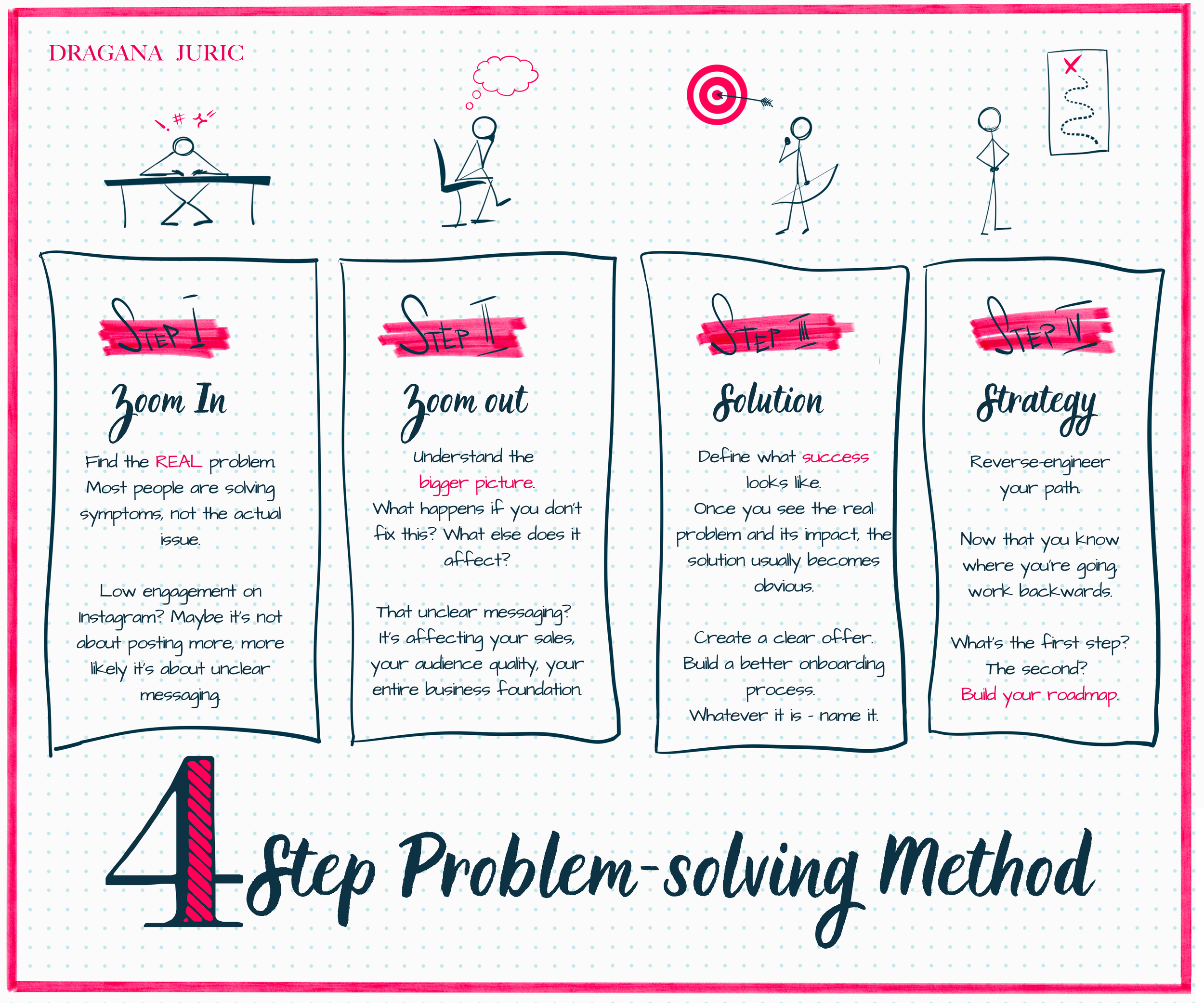
The 4 key steps to solving any problem:
Zoom in - Define the real problem
Zoom out - Understand the bigger picture
Solution - Propose a clear goal
Strategy - Create a plan and adjust as needed
The secret to applying this system effectively is focus. You need to clear away distractions and false leads, cut through the noise so you can zero-in on the actual cause.
Until you have this very clear in mind, it's best to write down each step as you think it through. And even when you do fully understand and adapt the problem-solving skill, you might still need some pen and paper to jot everything down, especially if the problems are complex. Writing will help you see connections and patterns more clearly.
Let's break down each step.
Step 1 - Zoom in
The first step is often the hardest. Pinpointing the real problem takes effort. Sometimes it's obvious, but many times we mistake a symptom for the problem and try to fix the wrong thing. When that happens, the issue keeps coming back. Or worse, it never really goes away.
Think of zooming in on a photo. There are a lot of details, but you need to find the specific one that's causing the problem. It might take several adjustments to finally focus on the right area.
Example: Low Instagram engagement
Imagine you have an Instagram account with low engagement. Nobody is reaching out to buy your product. You assume the issue is visibility, so you start posting more, making trending reels, and pouring energy into learning new content strategies. But nothing works. You burn out and give up.
What if the real problem isn't content volume but a lack of brand clarity? Maybe your followers don't understand what you offer, or your call to action is too vague. Zooming in deeper might show that your messaging or positioning is the actual issue.
Example: Employee turnover
Your freelancers or employees keep leaving. You think you just haven't found the right person yet. But even the good ones leave. The real problem might be poor onboarding, unclear expectations, low pay for the difficulty of the tasks, or a lack of structure. Zooming in helps you look past the surface and uncover what's really going wrong.
You'll know when you've found the true issue. Trust your instincts and don't be afraid to examine every part of your business until the answer becomes clear. It's important to understand that there are symptoms of a problem and then there is the problem. We want to cure problems, not symptoms. Take your time with this step.
Step 2 - Zoom out
Once you've identified the problem, it's time to zoom out and assess the impact. What areas of your business or life are affected by this issue? What happens if you don't solve it? What long-term consequences might develop?
Back to the Instagram example: without a clear offer, everything else starts falling apart. You attract the wrong audience, your content doesn't convert, your pricing feels off, and your sales stay inconsistent. This isn't just a marketing problem. It affects the survival of your business.
In the employee example, zooming out reveals how much time you're wasting constantly replacing people. Clients might notice the turnover and lose trust. You might start seeing your team as temporary, which affects how you treat them. All of this weakens your foundation.
Seeing the big picture is essential before moving forward.
Step 3 - Solution
Now comes the most satisfying part: defining the solution. Once you understand the problem and its impact, the answer often becomes obvious.
In the Instagram example, the solution is to create a clear and compelling offer that directly solves a problem for your audience. Without this, all your communication will feel empty, and sales will continue to fall flat.
In the team example, the solution is to create a profile of your ideal team member. What skills do they need? What qualities matter to you? Then you can design an onboarding process that gives them clarity and structure from day one.
Even if the solution feels difficult to implement or far away, that's okay. What matters is that you define it clearly so that you can move to the next step: the strategy.
Step 4 – Strategy
Now that you know the problem, understand the consequences, and have a clear goal, you can reverse-engineer your path toward the solution.
Instagram Strategy:
Your goal is to increase sales by crafting an irresistible offer. Start by defining your ideal client. Imagine their day-to-day life, struggles, desires, and fears. Design an offer that solves a real problem for them.
Then work backwards: how will you present this offer? What kind of content will support it? What marketing channels will you use? An Instagram story might need to grab attention quickly, while a newsletter can go into more depth. You'll also need a landing page, maybe ads, and a plan to monitor and adjust based on performance.
Team Strategy:
Your goal is to hire and retain better-fitting team members. Once you define who that person is, reverse-engineer how to find them. Create clear job descriptions, post on platforms that attract the type of person you want to work with, refine your interview process, build an onboarding guide, and give them a clear sense of expectations. Design small tasks to ease them into your workflow.
Step by step, your strategy will come together. If things don't work out, your system will let you adapt quickly and try again.
Conclusion
Problem-solving is not a one-time thing. It’s a way of thinking that becomes second nature over time. The more you practice these four steps, the faster and more effective you’ll become. Whether you’re navigating your personal life or building a creative business, knowing how to zoom in, zoom out, define your solution, and build a strategy will save you energy, time, and frustration.
Most importantly, it will give you back control. You’ll stop feeling stuck or reactive and instead move forward with clarity and intention.
That’s what running a business, and a life you love, is all about.