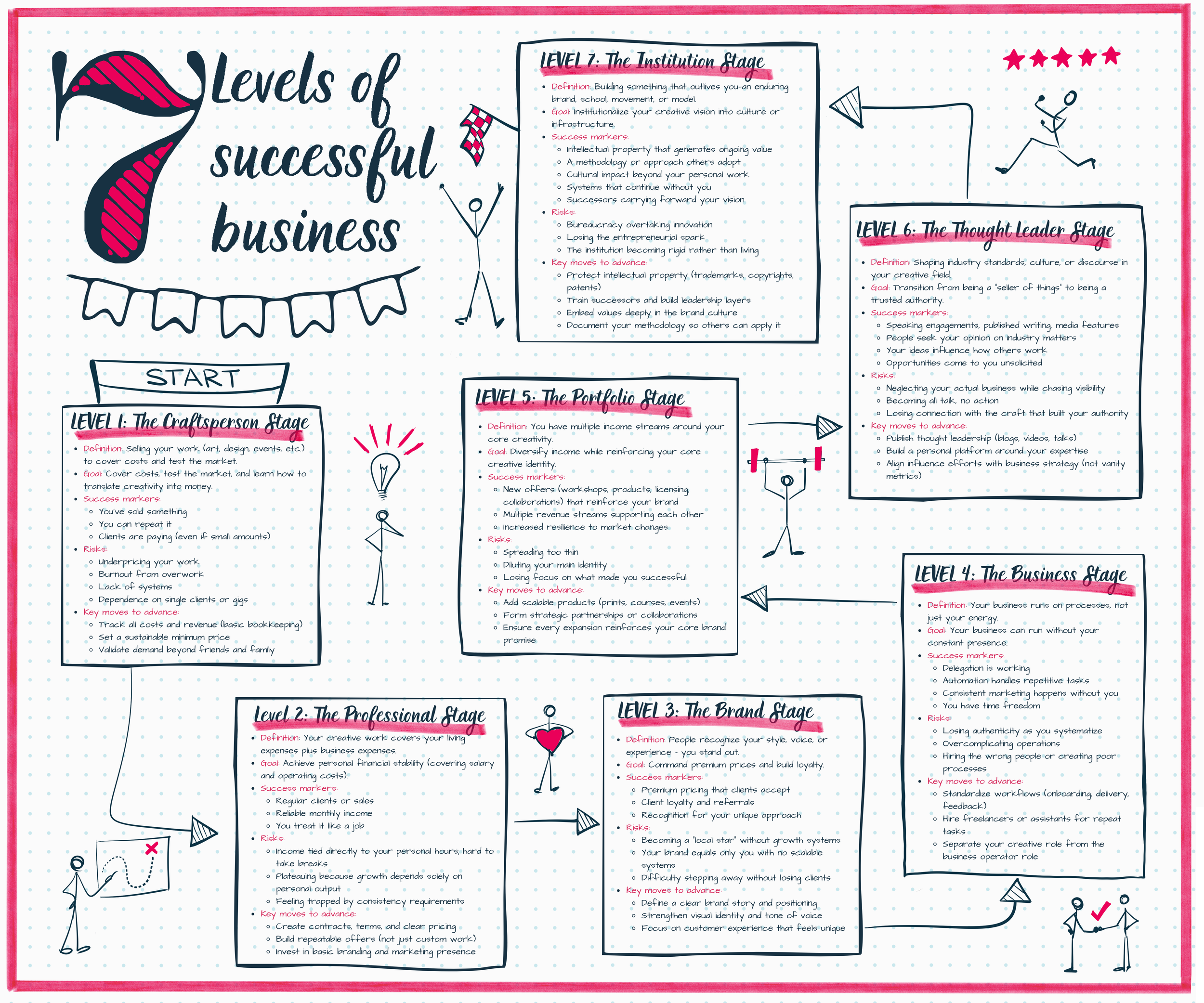
The 7 Levels of Successful Creative Business
Most creative entrepreneurs can't tell you where their business actually stands. They're moving, but they don't know if they're climbing or circling. After running four creative businesses at different growth stages, I needed a framework that would work across all of them - a map that could cut through doubt and point me toward what matters next.
This is that system.
Why this system matters
Unlike most business models, this framework isn't about tactics or trends. It's about leadership and mindset, its about the elements that don't expire. That's why it applies to any business, but it's especially crucial for creative, one-person enterprises where clarity and sustainability are everything.
Each level builds on the one before it, forming an upward arrow of progress and a pyramid of stability. At every stage, there are paradoxes to resolve, risks to navigate, and milestones that signal you're ready for the next ascent.
The key is to not skip levels too early: you cannot build legacy (Level 7) without stability (Level 2) or systems (Level 4). Each level builds economic and cultural capital, making you more resilient and impactful. If you show traits from multiple levels, you're usually strongest at the lower one. Focus there first. A shaky foundation will collapse under expansion or influence.
The goal is not just growth, but intentional growth. With clarity, meaning, and endurance.
Level 1: Survival (The Craftsperson Stage)
Definition: Selling your work (art, design, events, etc.) to cover costs and test the market.
Goal: Cover costs, test the market, and learn how to translate creativity into money.
Success markers:
You've sold something
You can repeat it
Clients are paying (even if small amounts)
Risks:
Underpricing your work
Burnout from overwork
Lack of systems
Dependence on single clients or gigs
Key moves to advance:
Track all costs and revenue (basic bookkeeping)
Set a sustainable minimum price
Validate demand beyond friends and family
This stage feels furthest from "business," yet this is where a business is first born.
Level 2: Stability (The Professional Stage)
Definition: Your creative work covers your living expenses plus business expenses.
Goal: Achieve personal financial stability (covering salary and operating costs).
Success markers:
Regular clients or sales
Reliable monthly income
You treat it like a job
Risks:
Income tied directly to your personal hours; hard to take breaks
Plateauing because growth depends solely on personal output
Feeling trapped by consistency requirements
Key moves to advance:
Create contracts, terms, and clear pricing
Build repeatable offers (not just custom work)
Invest in basic branding and marketing presence
You built a business for freedom, but here it can feel like you've just built yourself another job.
Level 3: Differentiation (The Brand Stage)
Definition: People recognize your style, voice, or experience - you stand out.
Goal: Command premium prices and build loyalty.
Success markers:
Premium pricing that clients accept
Client loyalty and referrals
Recognition for your unique approach
Risks:
Becoming a "local star" without growth systems
Your brand equals only you with no scalable systems
Difficulty stepping away without losing clients
Key moves to advance:
Define a clear brand story and positioning
Strengthen visual identity and tone of voice
Focus on customer experience that feels unique
The stronger your brand, the harder it is to step away. This is both your strength and your limitation.
Level 4: Systems (The Business Stage)
Definition: Your business runs on processes, not just your energy.
Goal: Your business can run without your constant presence.
Success markers:
Delegation is working
Automation handles repetitive tasks
Consistent marketing happens without you
You have time freedom
Risks:
Losing authenticity as you systematize
Overcomplicating operations
Hiring the wrong people or creating poor processes
Key moves to advance:
Standardize workflows (onboarding, delivery, feedback)
Hire freelancers or assistants for repeat tasks
Separate your creative role from the business operator role
The more you let go, the more the business grows. But letting go feels like losing yourself.
Level 5: Expansion (The Portfolio Stage)
Definition: You have multiple income streams around your core creativity.
Goal: Diversify income while reinforcing your core creative identity.
Success markers:
New offers (workshops, products, licensing, collaborations) that reinforce your brand
Multiple revenue streams supporting each other
Increased resilience to market changes
Risks:
Spreading too thin
Diluting your main identity
Losing focus on what made you successful
Key moves to advance:
Add scalable products (prints, courses, events)
Form strategic partnerships or collaborations
Ensure every expansion reinforces your core brand promise
The more you expand, the more disciplined you must be to stay centered.
Level 6: Influence (The Thought Leader Stage)
Definition: Shaping industry standards, culture, or discourse in your creative field.
Goal: Transition from being a "seller of things" to being a trusted authority.
Success markers:
Speaking engagements, published writing, media features
People seek your opinion on industry matters
Your ideas influence how others work
Opportunities come to you unsolicited
Risks:
Neglecting your actual business while chasing visibility
Becoming all talk, no action
Losing connection with the craft that built your authority
Key moves to advance:
Publish thought leadership (blogs, videos, talks)
Build a personal platform around your expertise
Align influence efforts with business strategy (not vanity metrics)
The more visible you become, the more invisible your actual business can become. Stay grounded in what built your reputation.
Level 7: Legacy (The Institution Stage)
Definition: Building something that outlives you—an enduring brand, school, movement, or model.
Goal: Institutionalize your creative vision into culture or infrastructure.
Success markers:
Intellectual property that generates ongoing value
A methodology or approach others adopt
Cultural impact beyond your personal work
Systems that continue without you
Successors carrying forward your vision
Risks:
Bureaucracy overtaking innovation
Losing the entrepreneurial spark
The institution becoming rigid rather than living
Key moves to advance:
Protect intellectual property (trademarks, copyrights, patents)
Train successors and build leadership layers
Embed values deeply in the brand culture
Document your methodology so others can apply it
True legacy requires stepping back. At this stage, it's no longer about you, but about what remains. This could look like: a design methodology that becomes industry standard, an art movement you initiated that others continue, a workshop model that gets franchised globally, or a creative philosophy that shapes how an entire generation works.
Conclusion
These seven levels aren't just a roadmap - they're a mirror. They show you where you are, what challenges you must face, and what mindset shifts are required to keep moving.
The truth is, you don't always climb them in order. You might circle back to lower levels when needed before you're ready to expand again. Your path may not be linear, and that's okay. What matters is that you progress with intention and a bigger goal in mind.
So, what level are you at right now? Look at the success markers, acknowledge the risks you're facing, and focus on the key moves that will take you forward. Don't try to skip ahead. Build your foundation solid, then climb with purpose.
That's how you create a creative business that lasts.